How to Choose the Right Engine Water Pump in 2026?

Time:2026-10-24 Author:Charlotte
0%

Choosing the right Engine Water Pump in 2026 requires more than matching a part number. Modern engines run hotter, use tighter tolerances, and depend on carefully controlled coolant flow. A pump that looks correct may still create overheating, bearing noise, or uneven cylinder temperatures. Small differences matter.

Gates automotive engineer Mike Kocur advises, “A water pump must move the right amount of coolant at the right pressure.” That principle should guide every purchase. Check the vehicle’s exact engine code, production year, impeller design, rotation direction, pulley arrangement, and housing material. Electric pumps require additional checks, including voltage, flow control, connector design, and electronic compatibility. Do not rely on appearance alone.

Real workshop experience also exposes less obvious risks. A mechanic may install a new pump beside a worn belt, corroded hose, or contaminated radiator. The new component then receives unfair blame. I have seen this assumption fail. The complete cooling system deserves inspection before installation. Look for dried coolant around the seal, shaft play, damaged blades, and staining near the pump housing. Follow the manufacturer’s torque and bleeding instructions carefully. Air trapped near the thermostat can imitate pump failure.

This guide explains how to compare original equipment, aftermarket, mechanical, and electric options in 2026. It also considers durability, efficiency, noise, warranty support, and total replacement cost. No pump is universally best. The right choice depends on the engine, operating conditions, maintenance history, and evidence available from a trusted supplier.
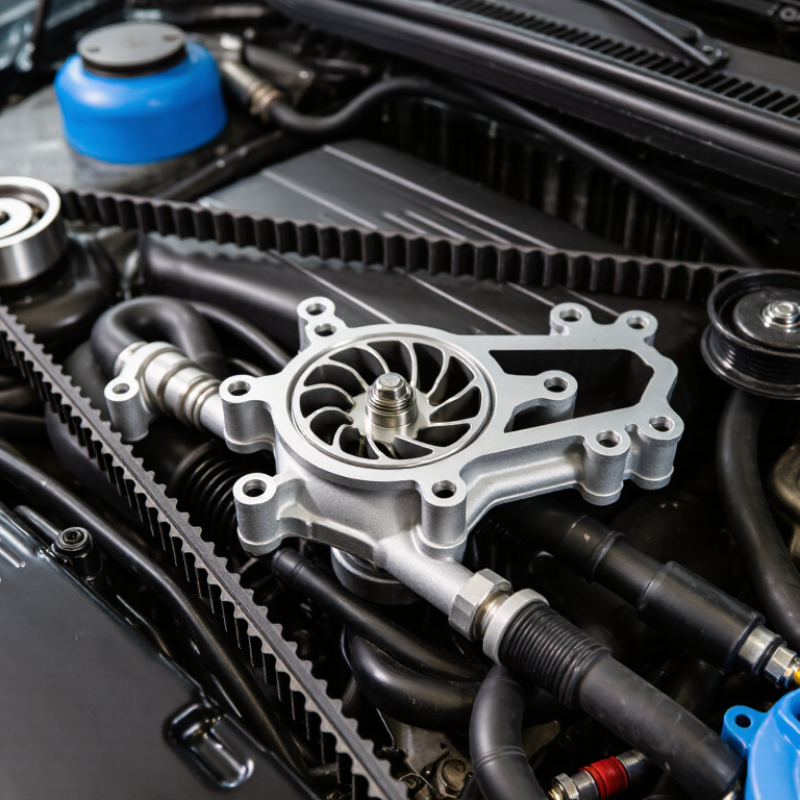
How to Choose the Right Engine Water Pump in 2026?

What an Engine Water Pump Does and Why It Matters

How to Choose the Right Engine Water Pump in 2026?

What an Engine Water Pump Does and Why It Matters

An engine water pump keeps coolant moving through the engine, radiator, and heater core. This circulation carries heat away from hot cylinder walls and combustion areas. Without steady flow, temperature can rise within minutes. Heat wins quickly.

The pump does not control temperature alone. The thermostat manages coolant timing, while the radiator releases stored heat. A worn impeller, leaking seal, or damaged bearing can weaken the entire cooling system. Warning signs include coolant drops, grinding sounds, steam, or a temperature gauge that climbs in traffic.

I once treated a small seep as harmless. That shortcut failed. A minor leak can empty the system after several drives.

When choosing a replacement, match the engine code, pump design, mounting points, pulley position, and required flow rate. Mechanical pumps often connect with a belt or timing system. Electric pumps depend on correct voltage, wiring, and electronic control.

Check the impeller material and shaft bearing quality, not only the purchase price. A poorly matched pump may fit physically but circulate coolant incorrectly.

That mistake can create hot spots and uneven cooling.

Inspect the thermostat, hoses, radiator, and coolant condition during installation. A new pump cannot compensate for blocked passages or air trapped inside the system. Follow the vehicle’s bleeding procedure carefully.

If the engine has overheated before, have the cooling system pressure-tested. I still prefer measured checks over assumptions; a quiet pump is not always a healthy pump.

Which Water Pump Types Fit Different Engine Designs

How to Choose the Right Engine Water Pump in 2026?

Engine design determines the correct water pump more than vehicle size does. A conventional mechanical pump suits many belt-driven engines. Its impeller moves coolant whenever the crankshaft turns. This design is simple and proven. However, cooling may be excessive during cold starts.

Electric water pumps fit engines needing independent coolant control. They can continue circulating coolant after shutdown. This helps turbocharged, hybrid, and compact engine systems manage heat. Some engines use auxiliary electric pumps beside a mechanical pump. Check the required flow rate, pressure, voltage, and controller compatibility. A pump with the wrong connector may fit physically but fail electronically.

Tips: Match the pump to the engine’s mounting points and coolant passages. Compare impeller size, rotation direction, and gasket position. Always inspect the service manual before ordering. In workshop checks, I also pressure-test the cooling system after installation. A quiet pump is not automatically a suitable pump. I once overlooked a small hose angle; the result was restricted flow and repeated overheating. That mistake still matters. Leave room for careful measurement. Check belt alignment, wiring protection, and coolant temperature readings during the first test drive. Shortcuts often hide inside “universal” parts.

How to Choose the Right Engine Water Pump in 2026? — Which Water Pump Types Fit Different Engine Designs

A practical comparison of common coolant-pump designs, engine applications, control methods, and selection criteria.

Engine Design or Application Best-Fit Water Pump Type Typical Drive and Control Why It Fits Key Selection Parameters Main Advantages Important Limitations
Conventional passenger-car gasoline engine with belt-driven accessories Mechanical centrifugal pump
Integrated or externally mounted
Driven by the timing belt, timing chain, or accessory belt; pump speed follows engine speed. Provides continuous coolant circulation without a separate electrical controller and matches the cooling architecture of many established engine platforms. Impeller design, pulley ratio, bearing life, seal compatibility, gasket type, flow at rated engine speed, and housing fit. Simple, durable, cost-effective, and capable of high flow at normal operating speed. Flow is linked to engine speed. It may provide more circulation than necessary at high speed and less control during cold start or idle.
Overhead-cam gasoline engine with an integrated timing-belt or timing-chain pump Integrated mechanical centrifugal pump Mounted on the engine and driven directly by the timing system. Reduces external packaging and can serve the cylinder head, engine block, thermostat circuit, and heater circuit through one compact assembly. Exact mounting geometry, timing-system service interval, shaft loading, coolant compatibility, seal material, and pump rotation direction. Compact installation and efficient packaging with fewer external drive components. A pump-bearing or seal failure may require timing-system disassembly. Incorrect installation can affect engine timing service work.
Large-displacement diesel engine for commercial vehicles, construction equipment, or generators Heavy-duty mechanical centrifugal pump
Gear-driven or belt-driven
Usually driven by engine gears or a dedicated belt; commonly designed for continuous operation and high coolant duty. Supports large coolant volumes, high thermal loads, long operating periods, and robust mechanical packaging. Required flow and head, cavitation margin, continuous-duty bearing rating, corrosion resistance, pressure capability, and service access. Strong continuous-duty performance, predictable operation, and suitability for high-load engine cooling systems. Adds mechanical drag and normally cannot vary pump speed independently from engine speed. Correct anti-cavitation design is essential.
Turbocharged gasoline or diesel engine with high transient thermal loads Mechanical main pump plus electric auxiliary pump Mechanical pump provides primary circulation; an electric pump supports turbocharger cooling, post-shutdown circulation, or a secondary circuit. Maintains coolant flow through hot turbocharger areas after the engine stops and can support low-speed or heat-soak conditions. Auxiliary-pump temperature rating, required post-run time, flow resistance, electrical current, hose routing, and controller logic. Improves heat-soak management without replacing the main high-flow pump. Adds wiring, controls, failure points, and electrical load. It is not automatically a substitute for the main engine pump.
Modern downsized engine requiring rapid warm-up and reduced parasitic loss Electronically controlled variable-speed electric centrifugal pump Brushless DC motor controlled by the engine management system using temperature, load, speed, and operating-mode inputs. Pump output can be reduced during warm-up and increased under high thermal load, helping separate engine cooling demand from crankshaft speed. Flow-versus-head curve, operating voltage, controller communication, maximum current, coolant temperature rating, EMC performance, and fail-safe behavior. Independent speed control, lower unnecessary circulation during warm-up, flexible packaging, and support for multiple coolant circuits. Higher electronic complexity and greater sensitivity to electrical, software, connector, and communication faults.
Stop-start passenger vehicle with frequent engine-off periods Electric main or auxiliary centrifugal pump Operates when the engine is off and is commanded by the thermal-management controller. Can maintain heater, turbocharger, battery, or engine-coolant circulation during automatic stop events and restart transitions. Low-speed flow, standby current, restart compatibility, noise, thermal protection, diagnostic feedback, and battery-voltage range. Supports cabin comfort and component cooling while the crankshaft is stationary. Must be matched to the vehicle electrical system and energy-management strategy; excessive standby consumption can reduce efficiency.
Hybrid vehicle with an internal-combustion engine and separate high-voltage components Multiple electric centrifugal pumps
Separate circuits are commonly used
Independent 12 V, 24 V, or high-voltage-compatible pump circuits controlled by the thermal-management system. Allows the engine, power electronics, motor-generator, battery, and cabin heating system to operate at different temperature targets. Dielectric separation where required, voltage class, insulation monitoring, flow control, coolant chemistry, noise, and fault diagnostics. Excellent zoning flexibility and continued circulation when the engine is stopped. More pumps and circuits increase system complexity. Coolants and components must be compatible with the specific circuit design.
Compact three-cylinder or four-cylinder engine with limited under-hood space Compact electric centrifugal pump
or integrated mechanical pump where packaging permits
Electric pump can be mounted near the radiator, engine, heater circuit, or a remote thermal module. Flexible mounting allows shorter packaging paths and can reduce dependence on accessory-belt alignment. Envelope dimensions, inlet orientation, connector location, vibration resistance, noise level, flow restriction, and cooling capacity. Flexible installation and independent operation at low engine speed or after shutdown. A remote pump may require longer hoses, additional clamps, and careful protection against air entrapment.
High-performance or motorsport-derived engine with high heat rejection High-flow mechanical centrifugal pump
or electronically controlled pump selected from the complete cooling-system curve
Mechanical drive for continuous high-speed operation or electric control for temperature-based flow management. Can be selected for high heat rejection, larger radiators, oil coolers, charge-air coolers, and demanding duty cycles. Pump head at target flow, cavitation resistance, maximum safe speed, coolant velocity, radiator pressure drop, and sustained-duty temperature. Supports high thermal capacity when the entire system is correctly matched. A larger pump is not always better; excessive flow can increase drag, pressure drop, erosion risk, or bypass-flow problems.
Stationary engine or generator operating at a nearly constant speed Mechanical centrifugal pump
or fixed-speed electric pump
Direct mechanical drive or electric control sized for the known operating point and duty cycle. A predictable engine speed makes it easier to match pump output, radiator capacity, and thermostat behavior. Continuous-duty rating, ambient temperature, coolant flow at operating speed, service interval, seal life, and standby requirements. Straightforward sizing and stable operating conditions. Fixed-speed systems may waste energy during low-load operation unless a thermostat, bypass, or variable-speed strategy is used.
Small engine with a low-power electrical system Mechanical centrifugal pump Belt, chain, or gear driven from the engine. Avoids continuous electrical demand and is suitable where the alternator capacity is limited. Available drive power, pump speed range, coolant flow, bearing load, seal durability, and cold-weather starting conditions. Minimal electrical-system impact and uncomplicated control. Cooling output cannot be independently optimized for warm-up, idle, or after-run operation.
Low-flow auxiliary circuit for cabin heating, battery cooling, or exhaust after-treatment Small electric centrifugal auxiliary pump Usually switched or pulse-controlled by a dedicated thermal-management module. Provides localized circulation without increasing the size or speed of the main engine pump. Required flow, pressure drop, self-priming capability, air tolerance, noise, electrical load, and continuous or intermittent duty rating. Easy zoning and operation while the main engine pump is stationary. Small pumps can lose performance when air-bound or installed with excessive hose restriction.
Systems requiring precise metering rather than conventional engine-wide circulation Positive-displacement pump — conditional use Electric or mechanically driven; output is closely related to pump displacement and speed. Useful for specialized low-flow metering or high-pressure auxiliary circuits where a centrifugal pump cannot provide the required control. Pulsation, relief protection, fluid viscosity, pressure rating, seal compatibility, heat generation, and filtration. Accurate displacement-based flow and strong low-speed pressure capability. Generally not the first choice for a conventional engine cooling loop because dead-heading, pressure spikes, and debris sensitivity require additional protection.
Any liquid-cooled engine where the replacement pump must match an existing system Do not choose by engine size alone Match the original drive type, rotation, control signal, mounting, and coolant-circuit layout. Pump compatibility depends on the complete cooling-system resistance and thermal requirement, not only on displacement or physical dimensions. Flow and head curve, operating temperature, pressure-cap rating, impeller clearance, shaft direction, connector pinout, gasket surface, and diagnostic protocol. Reduces the risk of overheating, cavitation, leaks, poor cabin heat, or control-system faults. A physically interchangeable pump may still have incorrect flow, rotation, control behavior, or electrical characteristics.
Selection note: Typical liquid-cooled engines operate with coolant temperatures commonly around 85–110°C, while the exact temperature, pressure, flow, and pump speed depend on the engine calibration and cooling-system design. Always verify the required pump flow at the system’s operating head, the pump’s maximum continuous temperature, drive direction, mounting geometry, coolant compatibility, electrical rating, and fail-safe strategy. A higher-flow pump is not automatically the correct pump if it causes excessive pressure drop, cavitation, belt loading, or thermostat and bypass-flow problems.

How to Match Pump Specifications to Your Vehicle

How to Choose the Right Engine Water Pump in 2026?

Matching a water pump to your vehicle requires more than comparing engine size. Check the model year, engine code, fuel type, and cooling system design. Two vehicles with similar engines may use different pump housings or pulley arrangements. The service manual remains the most reliable reference.

Confirm whether your vehicle uses a mechanical or electric pump. Then compare the required flow rate, pressure range, impeller design, shaft size, and mounting-hole pattern. The pump must also suit the belt or chain system. Measure the old unit carefully, including outlet positions and gasket surfaces. Small differences can cause leaks or poor coolant circulation.

Use the vehicle identification number when checking catalog information. A qualified technician can verify compatibility before installation. In workshop inspections, I have seen incorrect pumps fit physically but fail under heavy traffic or high temperatures. That mistake is expensive. I also prefer pumps with clear temperature and duty-cycle specifications, especially for hybrid or electronically controlled cooling systems. Coolant compatibility matters too. Mixing unsuitable materials may damage seals over time.

Do not ignore the gasket. A perfect pump with a damaged seal can still leak. Test the thermostat, hoses, and radiator while replacing the pump. Otherwise, an old cooling-system fault may be blamed on the new part. I sometimes rely too heavily on matching dimensions, and that is not enough. Specification matching needs context.

How to Choose the Right Engine Water Pump in 2026?

Match the pump’s operating flow to the vehicle’s engine displacement, while confirming pressure, impeller design, mounting pattern, and coolant-system compatibility.

The values shown are practical reference targets for conventional liquid-cooled passenger-vehicle engines at normal operating conditions, not manufacturer-specific specifications. Always verify the vehicle service manual and the pump’s flow curve before installation.

How to Compare Materials, Quality, and Operating Efficiency

Choosing an engine water pump requires more than matching bolt holes. Compare the impeller, housing, bearing, seal, and gasket as one system. Aluminum reduces weight, while cast iron often tolerates abrasion and heat better. Stainless steel can resist corrosion, but its price may not guarantee better cooling.

The U.S. Department of Energy’s 2024 Motor Systems Market Assessment reports that motor-driven systems use about 57% of U.S. manufacturing electricity. This broader finding matters: small efficiency losses can become expensive during long operating hours.

For engines, inspect pump flow, pressure, temperature limits, and parasitic load. A high-flow pump is not automatically efficient.

Material quality should be verified through hardness data, corrosion testing, dimensional inspection, and traceable production records. The water pump must keep stable flow at idle and higher engine speeds. Check whether the seal survives the specified coolant, not only clean water.

I once focused too heavily on impeller shape and underestimated bearing noise after extended heat cycles. That was a useful failure. Real operating conditions expose weaknesses that a bench test can miss.

ISO 17356-related quality practices and documented endurance testing can improve confidence, although certification alone cannot replace application testing.

Tips:

Compare measured flow curves, not advertising claims. Check shaft play before installation. Confirm the gasket surface is flat. Use the recommended coolant mixture and inspect the old pump for rust, cavitation, or belt misalignment.

The U.S. Department of Energy also emphasizes reducing friction and accessory losses in vehicle efficiency studies. That supports a practical choice: select the pump delivering adequate cooling with the lowest verified mechanical resistance, not merely the largest capacity.

How to Install, Test, and Maintain the Chosen Water Pump

Choosing the right engine water pump begins with the engine’s service specifications. Confirm the correct impeller design, mounting pattern, flow rate, and gasket type. A pump that fits physically may still circulate coolant poorly. Work only on a completely cold engine. Drain the coolant into a suitable container, and photograph hose positions before removal. I have seen rushed installations cause avoidable leaks because one small hose was connected incorrectly.

Clean the mounting surface without scratching it. Install a new gasket or approved seal, then tighten bolts in a cross pattern. Use the specified torque, not a guess. Refill with the recommended coolant mixture. Open the system’s bleed points if provided. Start the engine and let it idle while monitoring the temperature gauge, heater output, and coolant level. Stop immediately if the temperature rises sharply, coolant sprays, or unusual grinding begins. Do not open a hot radiator cap.

After the engine cools, inspect the pump seal, hose joints, and drain area for fresh moisture. Check belt tension and listen for bearing noise during the next few drives. A cooling-system pressure test can reveal a slow leak that is invisible at idle. Keep service records with the installation date, coolant type, and observed temperature. My own weak point is assuming a quiet pump is healthy; bearing wear can develop before obvious noise appears. Recheck the system after several heat cycles, because small air pockets sometimes surface later.

FAQS

What does an engine water pump do?

It moves coolant through the engine, radiator, and heater core. This carries heat away from cylinder walls. Without circulation, temperatures can rise within minutes.

What symptoms suggest a failing water pump?

Watch for coolant drops, grinding sounds, steam, or a rising temperature gauge. A small seal leak may worsen after several drives. Do not dismiss it.

Can a pump fit correctly but still work poorly?

Yes. Check the engine code, impeller design, mounting points, pulley position, and flow rate. Physical fit alone proves little.

What should be checked before choosing a replacement pump?

Confirm the required flow rate, gasket type, bearing quality, and impeller material. Electric pumps also need correct voltage, wiring, and control signals.

Should other cooling parts be inspected during installation?

Yes. Inspect the thermostat, hoses, radiator, coolant, and passages. A new pump cannot fix a blocked system or trapped air.

How should a water pump be installed safely?

Work only on a completely cold engine. Drain coolant into a suitable container. Photograph hose positions before removal. Small details matter.

How can the new pump be tested after installation?

Refill the system with the recommended coolant mixture. Bleed air as specified, then monitor temperature, heater output, and coolant level while idling.

What warning signs require stopping the test immediately?

Stop if the temperature rises sharply, coolant sprays, or grinding begins. Never open a hot radiator cap. Wait until the engine cools.

How can a slow leak be found?

Inspect the seal, hose joints, and drain area after cooling. A pressure test may reveal moisture that remains invisible during idle operation.

When should the cooling system be checked again?

Recheck it after several heat cycles and short drives. Air pockets may surface later. Keep records of installation date, coolant type, and temperatures. I sometimes assume quiet means healthy. It does not always.

Conclusion

Choosing the right Engine Water Pump in 2026 starts with understanding its essential role in circulating coolant through the engine, radiator, and cooling system. This process controls operating temperature, prevents overheating, and supports reliable engine performance. The best pump type depends on the engine’s design, including whether it uses a mechanical, electric, belt-driven, or chain-driven system. Before purchasing, drivers should match the pump’s specifications with their vehicle’s engine size, mounting arrangement, coolant flow requirements, pressure range, and compatibility with the existing cooling system.

Material quality and manufacturing precision also influence durability, efficiency, noise, and resistance to corrosion. A suitable pump should provide steady coolant circulation while minimizing energy loss and leakage risks. Proper installation is equally important: inspect related components, follow the vehicle’s service procedures, fill the system with the correct coolant, remove trapped air, and test for leaks and stable temperature control. Regular maintenance, including coolant checks and early attention to unusual noises or overheating, can extend pump life and protect the entire engine.


Charlotte

Charlotte

Charlotte is a seasoned marketing professional with a deep understanding of the company's portfolio and a passion for elevating its presence in the market. With a keen eye for detail and a commitment to excellence, she ensures that our professional blog is regularly updated with insightful articles......